
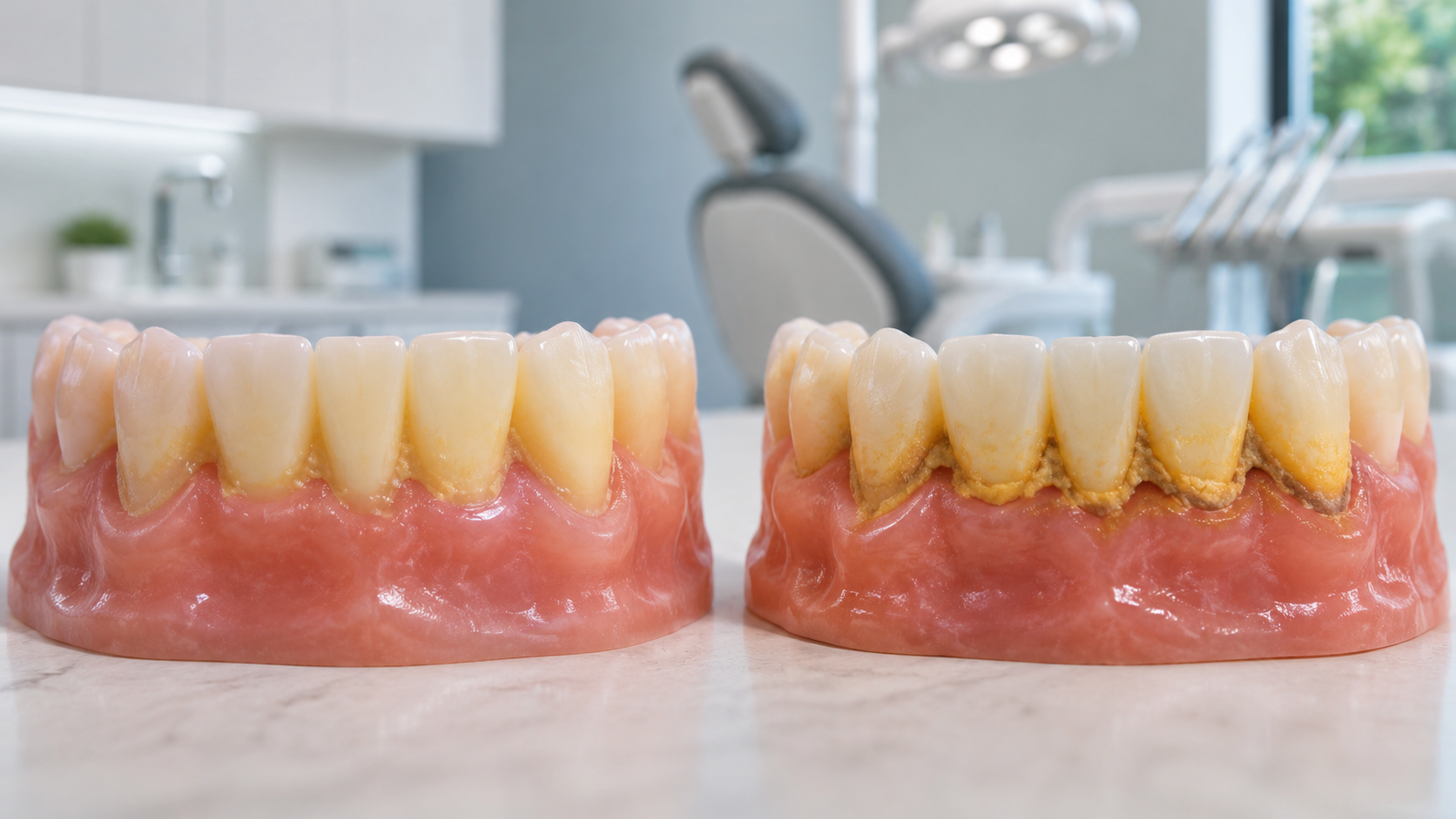
Plaque vs Tartar
Plaque vs tartar: what’s the difference? Dental plaque is a soft, sticky film of bacteria that continuously forms on your teeth, while tartar is plaque that has hardened after absorbing minerals from saliva. Plaque can be removed with regular brushing and cleaning between your teeth. Once it becomes tartar, also called dental calculus, professional dental cleaning is needed to remove it safely.
Both plaque and tartar can contribute to tooth decay, gum inflammation and other oral health problems if they are not managed.
At Cosmic Smile, we help patients understand how these deposits affect their teeth and gums, and what can be done to control them.
In this guide, we’ll explain how plaque turns into tartar, the signs of buildup, treatment options, prevention and when to arrange a dental examination.
What Is the Difference Between Plaque and Tartar?
The main difference between dental plaque and tartar is their consistency and how they are removed.
Plaque is a soft bacterial biofilm that forms on teeth every day. Tartar develops when plaque remains on a tooth long enough to become mineralised.
Once hardened, tartar adheres firmly to the tooth surface and cannot be reliably removed with ordinary brushing or flossing.
Plaque vs Tartar: Quick Comparison
| Feature | Dental Plaque | Dental Tartar |
| Texture | Soft, sticky film | Hard, rough deposit |
| Colour | Usually colourless or pale yellow | May appear yellow, brown or dark |
| Formation | Bacterial biofilm continually develops | Plaque becomes mineralised |
| Common location | Tooth surfaces and gumline | Along or beneath the gumline |
| Can brushing remove it? | Yes, with effective technique | No |
| Can flossing remove it? | Yes, between teeth | No |
| Professional treatment | Biofilm removal and preventive cleaning | Scaling with appropriate instruments |
| Oral health concerns | Tooth decay and gum inflammation | Plaque retention and periodontal inflammation |
Both substances are relevant to oral health.
The important point is that plaque can be controlled at home, while established tartar requires professional removal.
What Is Dental Plaque?
Dental plaque is a sticky layer of bacteria that develops naturally on the surfaces of teeth.
Your mouth contains many types of bacteria. Some attach to tooth surfaces and form an organised community called a biofilm.
As the biofilm develops, it becomes more difficult to remove without mechanical cleaning.
Plaque can form on natural teeth, fillings, crowns, dentures and other dental restorations.
What causes plaque buildup on teeth?
Plaque forms as bacteria attach to tooth surfaces and multiply.
Saliva contributes to a thin protective film on teeth, which provides a surface where bacteria can attach.
These bacteria interact with components of saliva and the foods and drinks you consume.
When certain plaque bacteria are exposed to sugars, they produce acids that can weaken tooth enamel.
Other bacteria within plaque can contribute to inflammation when the biofilm accumulates near the gums.
Plaque formation is a normal ongoing process, but allowing excessive buildup can increase your risk of dental problems.
What does dental plaque look like?
Plaque is often difficult to see because it can be nearly colourless.
You may notice a pale yellow or whitish film, especially around the gumline.
Common signs include:
- Teeth feeling fuzzy or coated
- A sticky sensation when running your tongue across your teeth
- Visible deposits close to the gums
- Persistent bad breath
- Red or irritated gums
- Bleeding during brushing or flossing
However, these symptoms do not always mean plaque is the only problem.
A dental examination can identify whether tartar, gum disease or another condition is present.
Does plaque develop even if you brush every day?
Yes.
Plaque continually reforms, even when you maintain good oral hygiene.
Brushing and interdental cleaning do not permanently eliminate bacteria from your mouth.
Instead, they disrupt and remove bacterial biofilm before it has time to accumulate excessively.
This is why brushing once every few days is not enough.
We recommend maintaining a consistent routine rather than relying on occasional intensive cleaning.
What Is Dental Tartar?
Tartar, also known as dental calculus, is mineralised plaque that adheres firmly to tooth surfaces.
It develops when plaque is not adequately removed and minerals from saliva contribute to hardening.
Tartar may form above or below the gumline.
Once established, it creates a rough surface that can retain additional bacterial plaque.
What does tartar look like?
Tartar often appears as a hard deposit near the gumline.
Its colour can vary.
You may notice:
- Yellowish deposits behind the lower front teeth
- Rough buildup around the gumline
- Brown deposits between teeth
- Dark deposits in areas affected by staining
- Hard deposits that do not move during brushing
Tartar can also develop below the gumline, where it may not be visible.
A patient may have relatively clean-looking teeth but still have deposits that require professional assessment.
Where does tartar build up most often?
Tartar commonly accumulates in areas influenced by saliva and plaque retention.
These include the inner surfaces of the lower front teeth and the outer surfaces of upper back teeth.
It can also build up around crowded teeth, orthodontic appliances and dental restorations.
Certain areas are naturally more difficult to clean, which can increase the chance of deposits forming.
At Cosmic Smile, we examine both visible surfaces and areas around the gums when assessing oral hygiene.
Is tartar the same as calculus?
Yes.
Dental calculus is the clinical term for tartar.
Both describe hardened mineralised plaque deposits.
The word calculus does not mean tooth decay or a cavity.
Instead, it refers to the hardened deposits that can accumulate on teeth and contribute to plaque retention.
How Does Plaque Turn Into Tartar?
Plaque turns into tartar through a process called mineralisation.
When plaque remains on the teeth, minerals from saliva can become incorporated into the bacterial biofilm.
Over time, these minerals harden the deposit.
How quickly does plaque turn into tartar?
Mineralisation can begin within days, although the process varies between individuals.
It is not accurate to assume that all plaque becomes hard tartar after a fixed number of hours.
Several factors influence how quickly deposits form, including:
- Saliva composition
- Oral hygiene habits
- Plaque accumulation
- Tooth position
- Gum health
- Individual susceptibility
Some people experience heavy tartar buildup despite regularly brushing, particularly in difficult-to-reach areas.
Others develop relatively little visible calculus.
The aim of daily oral hygiene is to remove plaque consistently before significant deposits accumulate.
Why do some people develop more tartar?
Differences in saliva, tooth anatomy and cleaning habits can influence calculus formation.
For example, crowded lower front teeth may create narrow spaces that are difficult to access with a toothbrush.
A person who does not clean between their teeth regularly may experience plaque accumulation in those areas.
Salivary mineral content also varies naturally between people.
We assess these factors when recommending cleaning tools and preventive care.
Is Plaque or Tartar Worse for Your Teeth?
Both plaque and tartar can contribute to oral health problems, but they do so in different ways.
Plaque contains bacteria that can produce acids and trigger gum inflammation.
Tartar provides a hardened surface where additional plaque can accumulate.
It is therefore misleading to think that plaque is harmless simply because it can be removed at home.
Can plaque cause cavities?
Yes.
Certain bacteria in plaque metabolise sugars and produce acids.
Repeated acid exposure can remove minerals from enamel.
If this process continues, tooth decay may develop.
Early decay may appear as a chalky white area before a visible cavity forms.
The risk depends on the balance between factors that damage and protect your teeth.
Fluoride toothpaste, saliva, diet and effective cleaning all play important roles.
Can tartar cause gum disease?
Tartar can contribute to gum disease by providing a rough surface that retains plaque and makes cleaning more difficult.
The bacterial plaque around the gums triggers inflammation.
Early gum inflammation is commonly called gingivitis.
If the inflammatory process progresses and affects the supporting tissues and bone, periodontitis may develop.
Not everyone with tartar has advanced gum disease, but persistent buildup increases the need for assessment.
Can plaque and tartar cause bad breath?
Yes.
Bacteria in the mouth can produce compounds associated with unpleasant breath.
Plaque accumulation, gum inflammation and deposits around the teeth may contribute.
However, bad breath can also have other causes, including dry mouth, tongue coating and certain medical conditions.
We assess the mouth rather than assuming tartar is always responsible.
How Do You Know if You Have Plaque or Tartar?
Plaque and tartar can sometimes be distinguished by how they feel, but appearance alone is not always reliable.
Soft, sticky deposits are more likely to be plaque.
Hard deposits that remain attached after brushing may be tartar.
Signs you may have plaque buildup
You might notice:
- A fuzzy coating on your teeth
- Sticky deposits around the gumline
- Bad breath
- Gum irritation
- Bleeding when cleaning
Because plaque is often nearly colourless, some deposits may be difficult to see.
Signs you may have tartar buildup
You might notice:
- Hard yellow or brown deposits
- Rough areas behind your lower front teeth
- Deposits that do not disappear after brushing
- Persistent plaque accumulation around certain teeth
- Gum inflammation near hardened deposits
However, not every dark mark on a tooth is tartar.
Staining, decay and other dental conditions can produce similar appearances.
Can tartar develop under the gums?
Yes.
Subgingival calculus forms below the gumline.
It may be associated with periodontal pockets and inflammation.
Because it is not always visible, a dental examination may be necessary to identify it.
We assess gum health and determine whether routine cleaning or more involved periodontal treatment is required.
How to Remove Plaque From Teeth at Home
Plaque can be removed through regular mechanical cleaning.
The most important steps are brushing twice daily and cleaning between your teeth every day.
1. Brush twice daily with fluoride toothpaste
Use a soft-bristled toothbrush and fluoride toothpaste.
Brush gently along the gumline and across all tooth surfaces.
Spend approximately two minutes brushing each time.
An electric toothbrush may help some people clean more effectively, particularly if they struggle with technique.
However, a manual toothbrush can also be effective when used correctly.
The Australian Dental Association recommends brushing twice daily with fluoride toothpaste.
2. Clean between your teeth daily
A toothbrush cannot adequately clean every surface between closely positioned teeth.
Floss, interdental brushes or other recommended cleaning aids can help remove plaque from these spaces.
The most appropriate method depends on tooth spacing and your oral health.
For example, floss may be useful for tight contacts, while interdental brushes may suit wider spaces.
We can demonstrate which tools are appropriate for your mouth.
3. Use a suitable brushing technique
Applying more pressure does not necessarily remove more plaque.
Excessive brushing force may contribute to gum recession or tooth wear.
Use gentle movements, ensuring you reach the inside, outside and chewing surfaces of your teeth.
Pay particular attention to the gumline.
4. Limit frequent sugary snacks and drinks
Sugary foods and drinks provide fuel for acid-producing plaque bacteria.
The frequency of sugar exposure is important.
Repeated snacking or sipping sugary drinks throughout the day can increase the number of acid attacks affecting your enamel.
Reducing these exposures can help lower your risk of tooth decay.
5. Maintain regular dental appointments
Even with consistent home care, some areas remain difficult to clean.
Regular examinations allow us to assess plaque levels, gum health and whether professional cleaning is needed.
We recommend an appointment schedule based on your individual risk factors.
Can You Remove Tartar From Teeth at Home?
No. Established tartar should be removed by a dental professional using appropriate instruments.
Brushing and flossing can remove soft plaque, but they cannot reliably detach hardened calculus.
Trying to scrape tartar away yourself can damage enamel, gums or restorations.
Does tartar-removing toothpaste work?
Some toothpastes contain ingredients intended to reduce calculus formation.
They may help slow the development of new deposits in certain circumstances.
However, they do not replace professional scaling and cannot be relied upon to remove established tartar.
We recommend choosing toothpaste based on your oral health needs rather than expecting it to dissolve existing calculus.
Can baking soda remove tartar?
Baking soda may help remove certain surface stains, depending on the formulation and how it is used.
However, it does not safely remove hardened calculus attached to the teeth.
Scrubbing with abrasive homemade mixtures may increase the risk of tooth wear.
We do not recommend using baking soda as a substitute for professional tartar removal.
Can vinegar or lemon juice dissolve tartar?
Acidic home remedies are not recommended.
Vinegar and lemon juice can expose enamel to acid and contribute to erosion.
Even if an acidic substance affects mineral deposits, using it on your teeth is not a safe way to remove tartar.
Repeated acid exposure may cause sensitivity and irreversible enamel wear.
Should you use a dental scraper at home?
No.
Sharp dental instruments require appropriate training and visibility.
Attempting to scrape deposits without professional guidance can injure the gums and damage tooth surfaces.
You may also miss deposits beneath the gumline.
If you can see or feel hard buildup, arrange a professional examination instead.
How Do Dentists Remove Tartar From Teeth?
Professional tartar removal generally involves dental scaling.
Scaling uses appropriate hand instruments or powered devices to remove hard deposits from tooth surfaces.
The cleaning approach depends on the amount and location of the buildup.
What happens during a scale and clean?
During a professional cleaning appointment, we first assess the condition of your teeth and gums.
We look for plaque, calculus and signs of inflammation.
Depending on your needs, treatment may involve:
- Examining the teeth and gums.
- Identifying areas of plaque and calculus.
- Removing deposits with scaling instruments.
- Cleaning suitable tooth surfaces.
- Polishing or biofilm removal where appropriate.
- Discussing home cleaning techniques.
- Recommending follow-up care when needed.
Patients with significant periodontal disease may require more extensive treatment than a routine scale and clean.
What is ultrasonic scaling?
Ultrasonic scaling uses a powered instrument with a vibrating tip and water irrigation.
The vibrations help disrupt and remove hardened deposits.
The water assists with cooling and irrigation during treatment.
Ultrasonic instruments can be useful for certain types of calculus removal.
However, the clinician may also use hand instruments for areas requiring additional attention.
The choice depends on the clinical situation.
Does professional tartar removal hurt?
Some patients experience little discomfort, while others notice sensitivity during scaling.
Discomfort may be more likely if the gums are inflamed, teeth are sensitive or deposits extend beneath the gumline.
We encourage patients to discuss sensitivity before treatment.
Depending on the procedure, adjustments or local anaesthesia may be considered.
It would not be accurate to promise that every cleaning appointment is completely pain-free.
What Is EMS Airflow Dental Treatment?
EMS Airflow is a professional dental cleaning system that uses a controlled combination of air, water and fine powder to remove bacterial biofilm and certain external stains.
At Cosmic Smile, we provide EMS Airflow Prophylaxis Master treatment as part of our dental hygiene services.
The system may be used alongside appropriate scaling techniques, depending on the patient’s needs.
Our article explaining Airflow dental treatment discusses how the technology works and where it may be useful.
Can Airflow remove plaque?
Yes.
Airflow technology is designed to disrupt and remove bacterial biofilm from appropriate tooth and restoration surfaces.
It can also remove certain external stains.
The powder, water pressure and technique are selected according to the treatment requirements.
However, professional biofilm removal does not replace daily brushing and interdental cleaning.
Plaque naturally reforms after treatment.
Can Airflow remove hardened tartar?
Airflow powder cleaning alone is not a substitute for scaling established hard calculus.
For hardened deposits, we may use compatible ultrasonic or manual scaling instruments.
An EMS Prophylaxis Master system can combine different cleaning technologies, but their functions are not identical.
This distinction is important when comparing plaque removal with tartar removal.
Biofilm removal focuses on soft bacterial deposits, while scaling addresses mineralised calculus.
Is Airflow suitable for stained teeth?
Airflow may help remove some external stains caused by coffee, tea, tobacco and other staining substances.
However, it does not bleach the natural internal colour of enamel in the same way as teeth whitening.
Not every type of discolouration responds to surface cleaning.
We assess the cause before recommending treatment.
Is Airflow suitable for everyone?
Not necessarily.
Although Airflow may be suitable for many patients, the technique and powder must be selected carefully.
Certain medical conditions, respiratory concerns and dental circumstances may require modifications or another cleaning method.
We review your health history and oral condition before treatment.
Plaque vs Tartar: Which Treatment Do You Need?
The appropriate treatment depends on whether the main concern is soft plaque, hardened calculus, gum inflammation or a combination of these.
| Dental Condition | Possible Management |
| Soft plaque buildup | Brushing, interdental cleaning and professional biofilm removal if indicated |
| Hardened calculus | Professional scaling |
| External staining | Suitable professional stain removal |
| Mild gingivitis | Plaque control, professional cleaning and review |
| Periodontal pockets with calculus | Periodontal assessment and treatment |
| Tooth decay | Examination and appropriate preventive or restorative care |
Not every patient requires the same cleaning procedure.
For example, a patient with light surface staining and healthy gums may need a different approach from someone with bleeding gums and deep periodontal pockets.
At Cosmic Smile, we assess your dental condition before explaining the proposed treatment.
You can explore our dental services to learn more about the care available.
Can Plaque and Tartar Cause Gum Disease?
Yes.
Bacterial plaque is a major cause of gingivitis and periodontitis.
Tartar can contribute by retaining plaque and making effective cleaning more difficult.
What is gingivitis?
Gingivitis is inflammation affecting the gums.
It commonly develops when plaque accumulates along the gumline.
Signs may include:
- Redness
- Swelling
- Bleeding during brushing
- Tenderness
- Changes in gum appearance
Gingivitis can often improve when the causes of inflammation are addressed.
However, ongoing symptoms should be assessed by a dental professional.
What is periodontitis?
Periodontitis is a more advanced inflammatory condition that affects the tissues and bone supporting teeth.
It can lead to periodontal pockets, gum recession and loss of supporting bone.
In severe cases, teeth may become loose or be lost.
Periodontitis requires professional assessment and management.
Good daily cleaning remains important, but advanced disease usually cannot be treated through home care alone.
Are bleeding gums normal?
Healthy gums generally should not bleed regularly during brushing or flossing.
Bleeding can be a sign of inflammation, although other factors may contribute.
According to Healthdirect’s guidance on gum disease, swollen or bleeding gums should be assessed by a dental professional.
If you notice persistent bleeding, we recommend arranging an examination.
How Much Does Plaque and Tartar Removal Cost in Australia?
Professional dental cleaning costs depend on the type of appointment, amount of buildup and whether additional periodontal treatment is needed.
A routine examination and clean may involve different fees from more extensive scaling or periodontal treatment.
What affects the cost of tartar removal?
Potential factors include:
- Amount of calculus present
- Whether deposits extend beneath the gums
- Gum health
- Number of areas requiring treatment
- Appointment duration
- Cleaning method
- Diagnostic examinations or imaging
- Whether additional visits are needed
For example, a patient with light deposits around a few teeth may require less treatment than someone with extensive calculus and periodontal inflammation.
Does private health insurance cover dental cleaning?
Some Australian private health insurance extras policies include benefits for preventive dental services.
However, cover depends on the policy, annual limits, waiting periods and treatment item numbers.
We recommend confirming your benefits directly with your insurer.
Is Airflow cleaning more expensive than regular cleaning?
The fee depends on the services included and the clinical treatment required.
Airflow may be provided as part of a hygiene appointment or alongside other cleaning procedures.
We recommend asking for a quotation that explains the treatment components.
At Cosmic Smile, we can discuss appropriate cleaning options after assessing your teeth and gums.
How Long Does a Professional Teeth Cleaning Take?
The length of a dental cleaning appointment depends on the condition of your mouth and the treatment required.
Some routine hygiene appointments may take approximately 30–60 minutes.
However, more extensive calculus removal or periodontal treatment may require longer or multiple appointments.
How long does tartar removal take?
Light deposits may be removed within a routine cleaning appointment.
More significant deposits, especially below the gumline, can require additional time.
We do not recommend choosing treatment based solely on how quickly it can be completed.
The aim is to remove the appropriate deposits while considering your oral health and comfort.
How often should you have a scale and clean?
There is no single appointment frequency suitable for everyone.
Some patients may be advised to attend approximately every six months.
Others, particularly those with periodontal disease or higher risk factors, may require more frequent reviews.
Patients with healthy gums and low risk may have a different maintenance schedule.
We recommend an individual recall interval based on your examination findings.
Can Tartar Return After Professional Cleaning?
Yes.
Plaque begins forming again after cleaning, and new calculus may develop if plaque remains on tooth surfaces.
Professional cleaning removes existing deposits but does not permanently prevent future formation.
How quickly can tartar return?
The rate varies between people.
Saliva composition, tooth position, oral hygiene and other factors influence how quickly deposits reform.
Some patients are more prone to visible calculus behind the lower front teeth.
Consistent brushing and interdental cleaning can reduce buildup, although they may not prevent all future deposits.
How can you keep your teeth clean after treatment?
After a professional cleaning, we recommend:
- Brushing twice daily with fluoride toothpaste
- Cleaning between teeth every day
- Following any specific gum care instructions
- Limiting frequent sugary drinks and snacks
- Avoiding tobacco
- Attending reviews according to your recommended schedule
Good oral hygiene is more important than relying on occasional cleaning appointments alone.
Is Plaque and Tartar Buildup Different for Children?
Children can develop plaque and calculus, although the pattern and extent may differ from adults.
Plaque accumulation is particularly important because baby teeth can develop decay.
Can children get tartar?
Yes.
Children may develop calculus, especially when certain areas are difficult to clean or plaque is not removed consistently.
However, not every visible deposit on a child’s tooth is tartar.
An examination can identify whether the concern is plaque, calculus, staining or enamel changes.
How can parents help prevent plaque?
Parents can support oral hygiene by supervising brushing and using age-appropriate fluoride toothpaste.
Young children often require help brushing effectively.
As children grow, they may also need assistance cleaning between teeth that touch.
We can demonstrate suitable techniques during dental appointments.
Can Braces, Crowns and Implants Collect Plaque?
Yes.
Plaque can accumulate around orthodontic appliances, restorations and implant-supported teeth.
These areas may require particular attention because standard brushing does not always reach every surface.
Plaque around braces
Fixed brackets and wires create additional spaces where plaque may collect.
Inadequate cleaning can contribute to gum inflammation and enamel demineralisation.
Orthodontic patients may benefit from interdental brushes and other recommended cleaning aids.
Plaque around crowns and bridges
The edges of crowns and the spaces beneath dental bridges can retain plaque.
Natural teeth supporting restorations can still develop decay.
We recommend cleaning carefully around restoration margins and beneath bridge pontics.
Plaque around dental implants
Dental implants cannot develop conventional tooth decay, but bacterial plaque can cause inflammation around the supporting tissues.
This may progress to peri-implant disease in susceptible patients.
We recommend appropriate cleaning tools and regular implant maintenance.
When Should You See a Dentist About Plaque or Tartar?
You should arrange a dental examination if you notice persistent deposits, bleeding gums, bad breath or changes in your teeth and gums.
A dentist can determine whether you need routine cleaning or further investigation.
Signs you should book an appointment
Consider arranging an assessment if you notice:
- Hard deposits near the gumline
- Persistent bad breath
- Bleeding during brushing
- Red or swollen gums
- Gum recession
- Sensitive teeth
- Discomfort when chewing
- Teeth becoming loose
- A change in how your teeth fit together
Some signs may indicate periodontal disease rather than a simple hygiene concern.
Early assessment can help identify appropriate treatment.
What happens during your examination?
At Cosmic Smile, we begin by discussing your oral health concerns.
We may assess the teeth, gums, plaque levels, calculus deposits and existing restorations.
Depending on your needs, we may recommend periodontal measurements or other investigations.
We then explain whether professional cleaning, periodontal treatment or additional dental care may be appropriate.
Why Choose Cosmic Smile for Dental Hygiene Care?
At Cosmic Smile, we provide general, preventive and cosmetic dental care in Neutral Bay, Sydney.
We offer EMS Airflow Prophylaxis Master treatment as part of our professional dental hygiene services.
Our approach focuses on assessing the condition of your teeth and gums before recommending appropriate cleaning methods.
What can you expect at our clinic?
During a dental hygiene assessment, we consider the amount and location of plaque and calculus, gum inflammation and areas that may be difficult to clean.
We can discuss brushing and interdental cleaning methods suited to your dental needs.
If professional treatment is required, we explain the available options and relevant limitations.
For example, soft plaque and external staining may be managed differently from hardened calculus.
Patients with periodontal disease may require more involved care than routine cleaning.
Where is Cosmic Smile located?
Our dental clinic is located at Suite 212, 40 Yeo Street, Neutral Bay NSW 2089.
You can find further details on our clinic location page.
We welcome patients who want advice about oral hygiene, plaque buildup, tartar removal and maintaining their dental health.
Quick Answers: Plaque vs Tartar FAQs
What is the main difference between plaque and tartar?
Plaque is a soft bacterial film that can be removed through brushing and interdental cleaning. Tartar is hardened mineralised plaque that requires professional dental removal.
Can you remove tartar from teeth at home?
No. Established tartar cannot be safely and reliably removed with ordinary home cleaning. A dental professional uses appropriate scaling instruments to remove hardened deposits.
How long does plaque take to turn into tartar?
Plaque mineralisation can begin within days, but the timeframe varies between individuals. Regular brushing and interdental cleaning help reduce plaque before significant calculus develops.
Is plaque or tartar responsible for gum disease?
Bacterial plaque is a major cause of gum inflammation and periodontal disease. Tartar contributes by retaining plaque and making cleaning more difficult.
Does Airflow cleaning remove tartar?
Airflow powder cleaning is primarily used to remove biofilm and certain external stains. Hardened calculus generally requires ultrasonic or manual scaling, which may be used alongside Airflow treatment.
Conclusion: How Can You Prevent Plaque and Tartar Buildup?
When comparing plaque vs tartar, the key difference is that plaque is soft and can be removed through daily cleaning, while tartar is hardened and requires professional removal.
Both can affect your oral health.
Plaque bacteria contribute to tooth decay and gum inflammation, while calculus creates surfaces where additional plaque can accumulate.
Brushing twice daily with fluoride toothpaste, cleaning between your teeth and attending recommended dental appointments can help control buildup.
If you already have hardened deposits, attempting to scrape them away at home may damage your teeth or gums.
At Cosmic Smile, we can assess your oral health and discuss suitable professional cleaning options, including EMS Airflow where appropriate.
Concerned about plaque or tartar buildup?
Contact our team at Cosmic Smile in Neutral Bay or call 02 9904 2880 to arrange a dental appointment.
We’ll examine your teeth and gums, discuss your concerns and recommend appropriate care based on your needs.
This article provides general dental information and does not replace an individual clinical assessment. Professional cleaning methods, treatment requirements, costs and outcomes vary. Patients with gum disease may require treatment beyond routine plaque and tartar removal.
